Greenland Row Sends Shockwaves Through US-European Trade Ties
New Trade Confrontation
Tensions between the United States and several European countries have intensified after Washington announced new trade tariffs linked to a growing diplomatic dispute over Greenland, a semi-autonomous Arctic territory governed by Denmark.
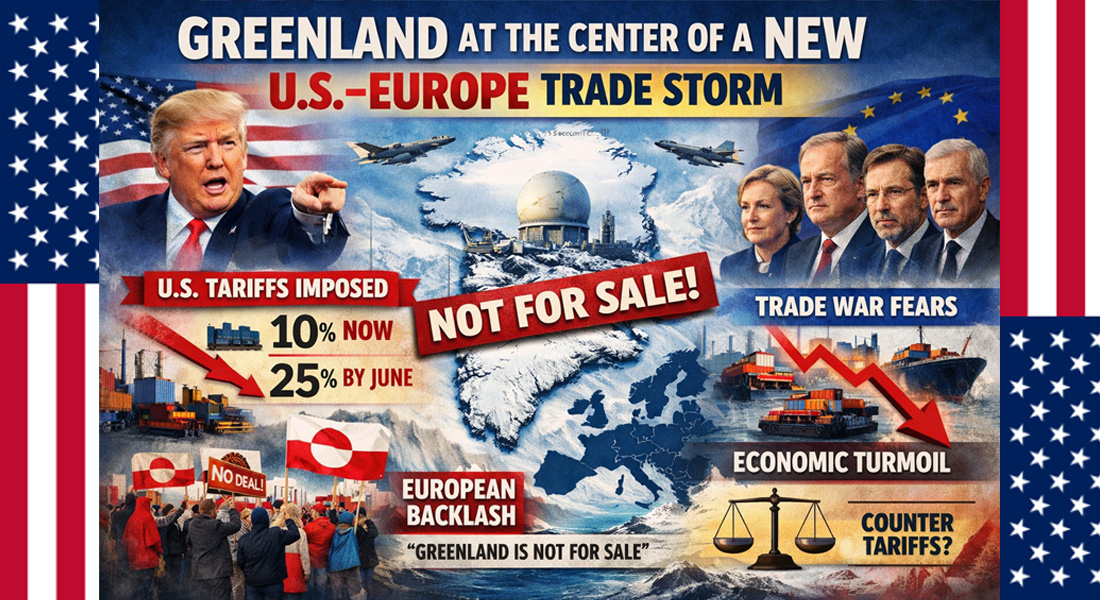
The U.S. administration has confirmed that it will impose additional import duties on goods coming from eight European nations, including Denmark, the United Kingdom, Germany, France, Sweden, Norway, Finland and the Netherlands. The initial tariff rate is set at 10 percent, with a warning that it could rise sharply in the coming months if negotiations fail.
According to U.S. officials, the decision is tied to national security concerns surrounding Greenland’s strategic location in the Arctic region. The island is seen as increasingly important due to rising geopolitical competition, expanding military interests, and its proximity to key Arctic shipping routes and missile-defence zones.
However, European leaders have strongly rejected Washington’s approach, calling the use of tariffs political pressure through trade. Denmark and Greenland’s local government have reiterated that Greenland’s future is not open to external negotiation and that any decision regarding the territory lies solely with its people.
The European Union has responded by signalling unity among member states and warning that counter-measures are being considered if the tariffs are implemented. Officials have also expressed concern that the move could undermine existing trade agreements and strain long-standing transatlantic partnerships.
Greenland’s leadership has taken a firm public stance, stating that the island is not for sale and that its political status is based on democratic self-determination. Public demonstrations and official statements from Greenland have reinforced opposition to any foreign control.
The dispute has already begun to impact broader diplomatic relations. Planned trade discussions between the U.S. and the European Union have slowed, and global markets are watching closely for signs of escalation. Analysts warn that continued tensions could lead to a wider trade confrontation at a time when global economic stability remains fragile.
Despite the sharp rhetoric, both sides have left the door open for dialogue. European diplomats have called for diplomacy over confrontation, while U.S. officials insist negotiations remain possible if security concerns are addressed.
As the tariff deadline approaches, the Greenland issue has emerged as more than a regional disagreement – it now represents a significant test of U.S.–European relations and the future balance between security, sovereignty, and global trade.