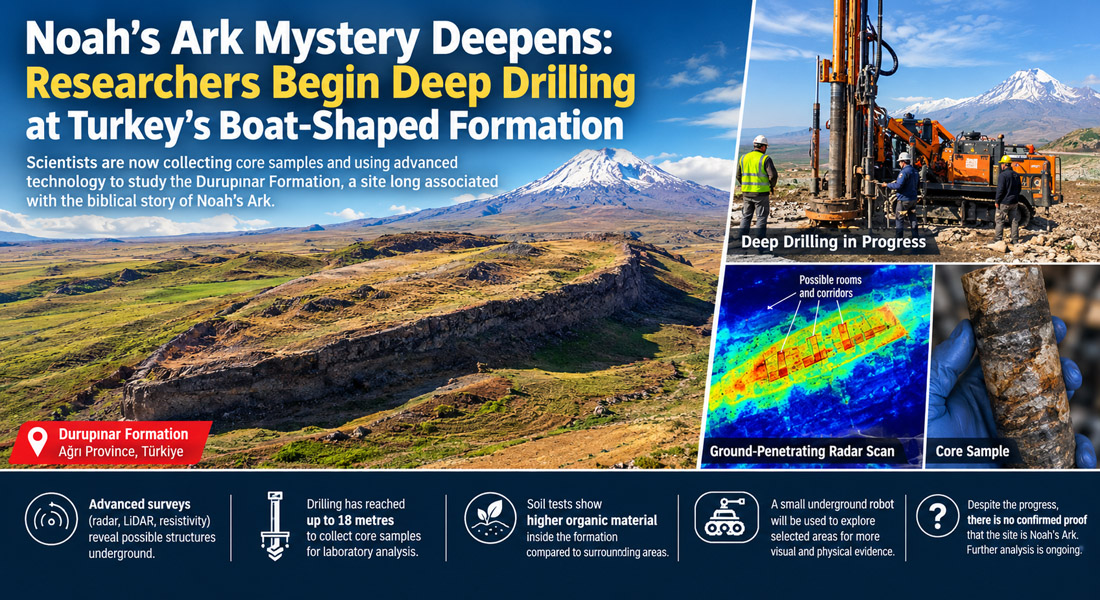
Doğubayazıt, Türkiye: A decades-old mystery surrounding a boat-shaped geological formation in eastern Türkiye has entered a new phase after researchers began deep drilling and subsurface investigations at the site associated with the biblical story of Noah’s Ark.
The Durupınar Formation, located in Ağrı province near Mount Ararat, has attracted attention since it was identified in aerial photographs in 1959. Measuring approximately 157 metres in length, the unusual formation has long been debated by researchers, with competing explanations suggesting either a natural geological structure or the remains of an ancient vessel.
In 2026, the investigation has moved beyond surface observations and remote sensing. A research program led by archaeologist Prof. Dr. Cenker Atila of Sivas Cumhuriyet University, together with an international research team, received official authorization from Turkish authorities to conduct detailed geological and geophysical investigations at the site.
Researchers have used ground-penetrating radar, electrical-resistivity surveys, LiDAR mapping and soil sampling to examine what lies beneath the formation. The project’s published research notes that earlier surveys identified unusual linear features, right-angle patterns and possible corridor- or room-like structures underground. However, the researchers themselves stress that these observations are suggestive rather than conclusive.
One of the latest developments is the collection of core samples from deeper sections of the formation. According to the research team, drilling has reached depths of up to approximately 18 metres, allowing material from beneath the surface to be collected for laboratory analysis. The team has also reported encountering cavities and organic-rich layers during the drilling programme.
Soil testing has produced another point of interest. Researchers reported that samples taken from inside the formation contained approximately three times more organic material than samples collected from surrounding areas. The finding is being investigated further, but organic-rich soil alone cannot establish that the material came from a wooden ship.
The research team has also announced plans to use a small underground robotic system to investigate selected subsurface spaces identified during earlier surveys. The objective is to obtain additional visual and physical evidence without carrying out large-scale excavation.
Despite the renewed excitement, there is currently no independently verified archaeological evidence proving that the Durupınar Formation is Noah’s Ark. The site’s unusual appearance has been debated for decades, and geological explanations for its formation remain part of the wider discussion.
The current investigation is therefore significant mainly because researchers are now collecting physical samples that can be subjected to laboratory testing. The research program says the samples and other findings will undergo further analysis, with additional scientific results expected as the project progresses.
For now, the Durupınar Formation remains an intriguing archaeological and geological mystery rather than a confirmed discovery of Noah’s Ark. The results of laboratory testing and independent scientific examination will be crucial in determining what the unusual formation actually contains.
Dynamic Leader News Desk
Prathiban DC