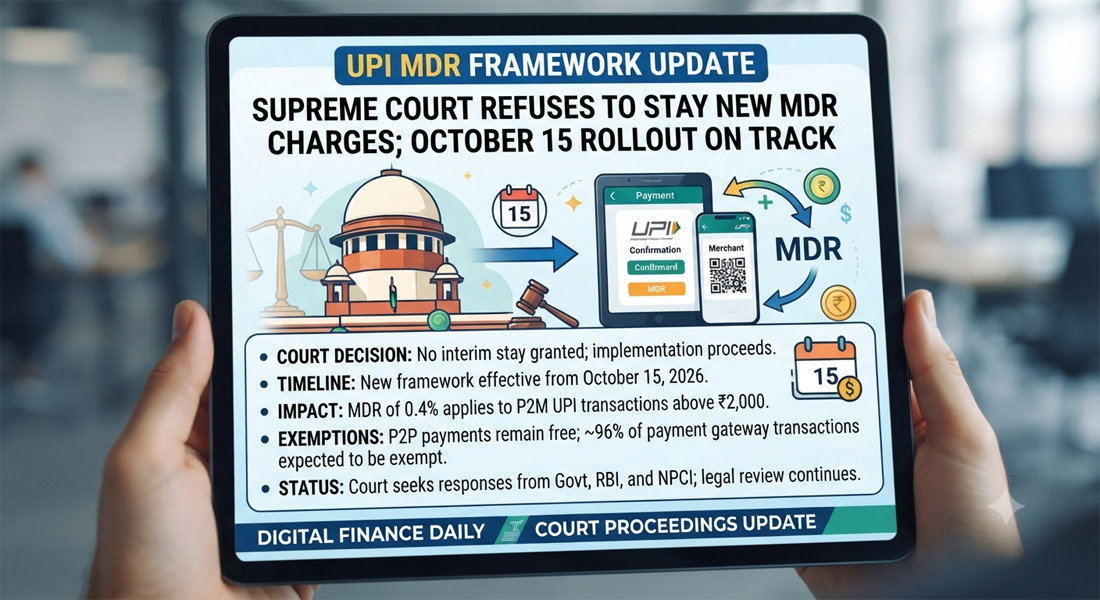
Supreme Court Refuses to Stay New UPI MDR Framework, October 15 Rollout Remains on Track
New Delhi, September 29, 2026: The Supreme Court has declined to grant an interim stay on the Centre’s decision to introduce a Merchant Discount Rate (MDR) on specified Unified Payments Interface (UPI) person-to-merchant transactions above 2,000. The decision means the proposed framework remains scheduled for implementation from October 15, 2026, unless there is a further order or policy change.
A three-judge bench headed by Chief Justice of India Surya Kant, along with Justices Joymalya Bagchi and V. Mohana, was hearing a petition challenging the government’s notifications introducing the new UPI merchant-payment framework.
Instead of stopping the proposed rollout, the court has sought responses from the Union government, Reserve Bank of India (RBI) and National Payments Corporation of India (NPCI). The respondents have been asked to submit their replies within four weeks. The court has also questioned the legal basis and nature of the proposed charge.
Under the new framework, eligible person-to-merchant UPI payments above 2,000 will generally attract an MDR of 0.4 per cent. The charge is subject to limits, including a maximum MDR of 300 for transactions of 75,000 and above. Payments between individuals will continue to remain free.
The government has maintained that MDR is not a tax or government fee. Instead, it is described as a charge within the digital payments ecosystem, with the amount distributed among participating entities involved in processing the transaction. The government has also stated that the MDR should not be separately recovered from customers.
The framework also provides exemptions and special provisions for certain categories. According to the Centre’s submissions before the Supreme Court, around 96 per cent of transactions routed through payment gateways are expected to remain exempt. Certain essential-service transactions will have a lower cap, while small merchants covered under the zero-MDR framework will continue to receive payments without the new charge.
The proposed change comes after nearly six years during which UPI merchant payments operated without a conventional MDR. The government has argued that the revised system is intended to support the long-term sustainability of the digital-payment ecosystem as transaction volumes continue to expand.
For ordinary UPI users, the immediate impact is expected to be limited because the proposed MDR is structured as a merchant-side charge rather than a direct customer transaction fee. However, the treatment of the additional cost by individual businesses could become an important issue once the framework takes effect.
- The Supreme Court’s latest order does not finally determine whether the MDR framework is legally valid. The court has only declined to halt its implementation at this stage while seeking responses from the concerned authorities.
The next phase of the case will therefore focus on the government’s legal and technical justification for the framework. Until the court issues another direction, the proposed October 15 implementation date remains unchanged.
Dynamic Leader News Desk
Prathiban DC